Almost everyone who comes to Udawalawe wants to do both, and the only hard part is the timing — the Transit Home feeds on a fixed schedule and the best safari hours sit right on top of one of the sessions. This page is about getting that timing right and booking the day as one trip. If you want the full reference on the centre itself, our complete Elephant Transit Home guide covers its history, rules, conservation work and 30 FAQs.
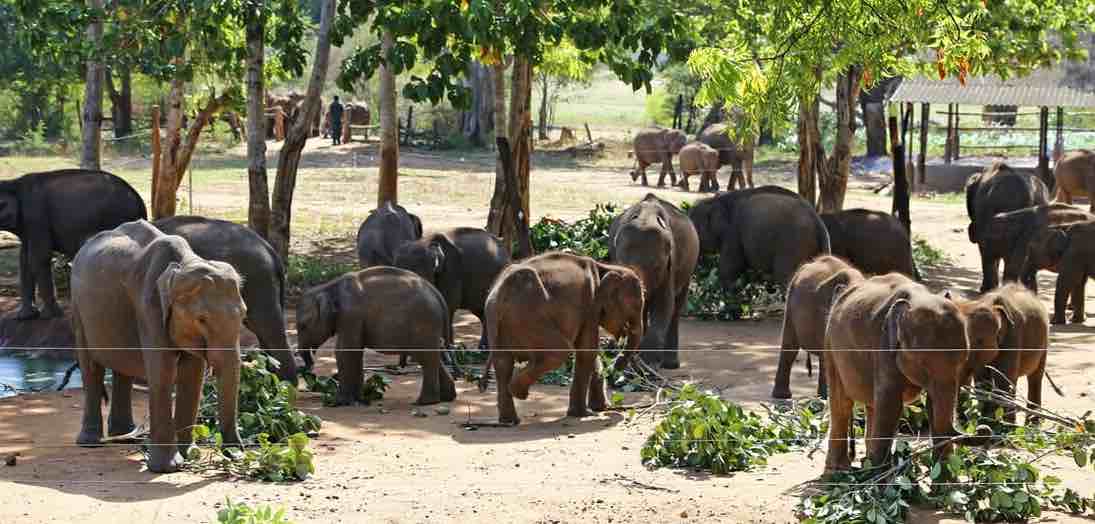
Which feeding fits which drive
There are four feeding sessions a day. Only two of them combine well with a safari, and one actively clashes.
| Feeding | Combines with | Verdict |
|---|---|---|
| 9:00 AM | Nothing — it lands mid-drive | Avoid if you want a safari the same morning |
| 12:00 PM | Morning safari (6:00–9:30 AM) | Our recommendation — and quieter than 9 AM |
| 3:00 PM | Afternoon safari, straight after | Good if you want a lie-in |
| 6:00 PM | Nothing — the park closes at 6:00 PM | Standalone visit only |
Feeding times are set by the Department of Wildlife Conservation and are approximate. We build your pickup time around whichever session you choose.
The day we normally run
| Time | What happens |
|---|---|
| Pre-dawn | Hotel pickup in an air-conditioned vehicle |
| 5:45 AM | Arrive at the gate — toilets, then into your private jeep |
| 6:00–9:30 AM | Morning drive: elephants, buffalo, crocodiles, eagles |
| 10:00 AM | Breakfast and a proper break |
| 12:00 PM | Noon feeding at the Elephant Transit Home |
| Early afternoon | Back at your hotel |
Why do both rather than just the safari
- They show you different things. The drive is wild elephants at distance; the Transit Home is orphaned calves close up, and the contrast is the point.
- It rescues the day with children. Three hours in a jeep with no toilet stops is a lot. The feeding is short, shaded and has facilities.
- It is the ethical alternative to the elephant attractions further north — the calves here are raised for release back into the wild, with no riding, bathing or chains.
- It costs very little extra. Entry is a few dollars a head on top of the safari.
What's included
- Private 4WD safari jeep — up to 6 passengers, never shared
- Udawalawe National Park entrance tickets and government fees
- Elephant Transit Home entry — a separate ticket, arranged for you
- Experienced naturalist guide
- Hotel pickup and drop-off, bottled water, child seats on request
Meals are the only extra. Packages start at $50 per person and vary with group size and pickup point — see the full official breakdown on the Udawalawe safari price page.
🐘 Book the combined day
Tell us your date, your hotel and which feeding you want — we set the pickup time around it.
❓ Booking the combined day
Can we do the safari and the Transit Home on the same day?
Yes — it is our most-booked itinerary. The centre is minutes from the park gate, so a morning drive ending around 9:30 AM leaves time for breakfast before the noon feeding. You are back at your hotel in the early afternoon.
Which feeding should I book my safari around?
The noon session with a morning drive — quieter than 9 AM and the timing is clean. Prefer a late start? Take the 3:00 PM feeding then go into the afternoon drive. The 9:00 AM feeding clashes with the best of the morning safari.
Do we need two separate tickets?
Yes — separate entrances, separate tickets, and a park ticket does not cover the Transit Home. On a combined tour we handle both, so there is nothing to sort out at the gate.
How much does the combined day cost?
From $50 per person, depending on group size and pickup point — private jeep, park tickets, guide, hotel transfers and Transit Home entry included. Meals are the only extra. Full price breakdown.
Is it too much for young children?
It actually works better than a safari alone — the feeding is the short, shaded, toilet-equipped half of the day, and the break between the two is what makes it manageable. More detail: Udawalawe safari with kids.
Can I visit the Transit Home without a safari?
Yes — own entrance, own ticket, about 45 minutes. We can arrange a transfer for it on its own if you are not doing a drive.
Keep planning: Complete Elephant Transit Home guide & 30 FAQs · Udawalawe safari options · Safari with kids · Safari prices 2026 · Park guide